Friday, July 21, 2006

it's good to know

Save the Children asks Serb, Albanian, and international negotiators on the status of Kosovo to include the issues of education and protection of children on their agenda.

Croatia makes government policy to develop and use open source. Among the advantages mentioned is cost reduction, independence from foreign suppliers, and development of local IT industry. It remains to be seen whether they will go all the way or whether Microsoft will make an unresistable offer.

First quarter of 2006 saw an increase in exports by 20%. Trade deficit is also slightly down. There are alarm bells going on about the exit of UNMIK early next year and its impact on the economy. A 1.6% slowdown is predicted. Jobless rate is also up and will most likely continue to stay on this level for a long time to come until productivity is brought up on par with wage levels demanded by the job seekers. Those of my countrypeople that expect more jobs with privatization and independence are bound for a big disapointmnet in the coming year, if that is possible at all after the last seven years.

One of the anomalies of the Kosovar economy is that despite the level of poverty its prices are some of the highest in the region. Kinda like Moscow being one of the most expensive cities in Europe. This effect is due to the impact that UNMIK expenditures of the international staff on local services and its local staffs wages. Remittances from emigrants, while lifesavers in some aspects, also skew the prices for the general consumer. Home prices in Kosovo with a 40% poverty rate are up to double of those in Serbia with a 9% poverty rate. This is one of the reasons why Serbs have been selling off so much after the war.

Economy-wise I'm ambivalent about UNMIK leaving. The economy that has developed to service UNMIK is one of house renting and restaurants. Yet Kosovo does not have a future on city tourism. What has resulted is a fake economy that is unsustainable, as we are bound to find out next year.
UNMIK stated that it has spend 2.6 billion on Kosovo, but I wonder how much of this actually went and stayed in the local economy. It is a common practice for EU to commission a study or project and have all the managers paid at incredibly high levels ($10,000/month) come from the countries commissioning the study. True, the residual effect of the experts' works is supposed to remain in Kosovo (with KEK, the poster child of EU expert work, an example of it), but at the same time is it fair to list these donations as contributions to the local economy? Another example is where KFOR could have helped but didn't. My father did some business with one of the countries' KFOR troop supplier (PX). The supplier had an explicit order to import everything possible from the mother country and the mere fact that the PX was doing business with a local business would have lost the contract to the PX if it was discovered. This is neat example of how mother countries expect the money of their "contributions" abroad to go back home instead of what potentially could have been a much more powerful and long term boost to the local food industry than spending money in rent and restaurants.

Similarly, a lot of the reconstruction was done at a time when Kosovo was still recovering resulting in everything being imported. Kosovo's neighbors, including lately the country that burnt those homes itself (Vetëvendosje likes to point out), were the big winners in the process of reconstruction with their industries ready to respond to the needs of Kosovo immediately after the war.

Not to be unthankful, but I'm all for figuring out how much money actually goes to feed the hungry African children, and how much to feed the Western bureaucracy that makes the aid possible.



Monday, July 17, 2006

Hilariously smart stuff at the "Unencyclopedia, the content-free encyclopedia that anyone can edit." Here are some articles: Yugoslavia, Yugoslav wars, Serbia (my favorite; with quotes from Oscar Wilde), Albania. Kosovo doesn't have one yet.

From Belgrade Cleansers:

In 1996, the Cleansers played and defeated the Kosovo Kosovars in the playoff games of the season. This allowed the team to reach the World Series in over eighty years. However, despite high hopes, the Cleansers suffered a humiliating defeat against the Washington Generals.

This was the final event that utterly destroyed Miloševi�'s credibility as General Manager. In the following year, he was voted off his position by the Board of Directors and replaced by Vojislav Koštunica. After that, Milosevic spent some time in The Hague learning from the best players in the trade and hoping to improve "the Serbian style" that was slightly out-of-date. He died there among colleagues and was buried in Pozarevac. Thousands of loyal fans gathered to say last good-by to him, while at the same time thousand were celebrating the same event at their homes.

Sunday, July 16, 2006

Veton Surroi of the Reformist Party ORA is hardly an extremist. Here's what he said to Voice of America in Albanian in an interview published on Saturday:


VOA
: Mr. Surroi, in July the meeting between leaders of Kosovo and those of Serbia will take place. What is expected from those talks when it is known that parties based on yesterday's stances at the UN have not backed off from their positions?

Veton Surroi: We don't know yet what it is about since Mr. Ahtissari hasn't sent the invitations yet, but nevertheless we see that from Belgrade we don't have the least signal of cooperation in this negotiation process so you ask the right question.

VOA: Since there hasn't been a compromise, how do you see the future of these talks, I'm talking about the political status?

Surroi: Political status shouldn't even be discussed with Belgrade. Belgrade has lost a long time ago the right to think, let alone to discuss about the political status of Kosovo. Negotiations develop in two main planes; the first plane is what the level of interference of international community in the independent Kosovo will be, and this due to the unfortunate fact that Kosovo in the last seven years of bad government hasn't shown enough ability to function as a functional democratic state. The second plane has to do with the minority rights, that is what is the level of minority rights to be assured in Kosovo.

VOA: […] would you accept to negotiate for a limited sovereignty of Kosovo's independence and for e delay of the independence process, for its stages?

Surroi: Sovereignty is already limited for the mere fact that we are not talking for sovereignty as the other countries have, but for sovereignty accompanied with internationals presence. Our red line in this direction would be Kosovo an international subject. Kosovo at the end of this process must be a UN member.

VOA: Mr. Surroi, I would like to stop a little bit to the idea you expressed a little earlier for the absence of a functional state in Kosovo. As it's known, those that argument today against Kosovo independence among other things say that independent Kosovo would be an unstable place because of the widespread organized crime. How wide is this phenomenon in your society?

Surroi:
I think the argument has to be seen differently. The fact that we have had here seven years of management from the UN hasn't created a functional democratic state is because it hasn't created a responsibility system. Only an independent state of Kosovo can be democratic and functional because it creates the relationship of responsibility with its citizens.

VOA:
Mr. Surroi, Albanian leadership of Kosovo says that the situation of the Serb minority in Kosovo is secure and it has freedom of movement and adds that the idea that minorities are not safe is more a matter of image than reality. Representatives of Serb minority have different opinions. You have headed an attempt for the creation of a legal framework for minorities. What is you opinion for the situation of Serb minority? Will Kosovo fulfill this standard?

Surroi: Unfortunately we have a bad legacy with the Serb community in Kosovo. At the beginning due to the negative stance of Serb community, I say general responsibility with the Milosevic regime, meaning when Serb community was used for Milosevic's politics, but of course after the war there has been a punishment of Serb community in Kosovo. I can't say that Serb community is absolutely free, absolutely with all the rights. On the other hand it's not also true that this community has shown willingness to integrate in this society. So there still is a lot of work to be done in both directions.

Seven hot summers later and in Kosovo there is about as much power as in Baghdad.

From Saturday's Express:

Current Energy Situation
Production Unit                    Power (MW)
A1                                       0
A2                                       0
A3                                      120
A4                                        0
A5                                      110
B1                                       0
B2                                      255
Ujmani                                 0
Import                                  0
Total                                               485

should we shout should we scream
"what happened to the post war dream?"
oh maggie maggie what have we done?

Saturday, July 15, 2006

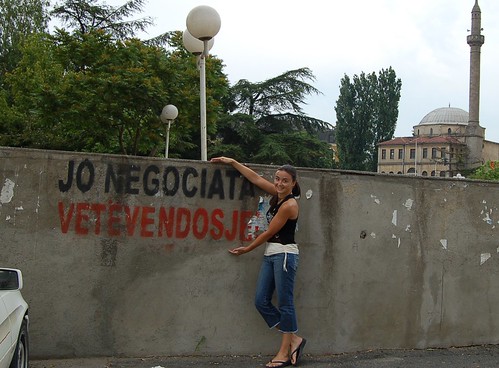
graffiti


grafitti, originally uploaded by kore_luke.

One of the better ways to put the message across. Graffiti on the wall reads "NO NEGOTIATIONS/ SELFDETERMINATION," wich is the motto of Vetevendosje! Movement.

Thursday, July 13, 2006

Pupovac happens to be the man that led Serbs of Croatia towards integration. PM Ceku wanted to bring him as an advisor for minority issues before he rejected. Is Ivanovic thinking something along the same line? Ivanovic might still have to play tough for PR reasons but it's a good idea to start talking to Pupovac early on.

Wednesday, July 12, 2006

Pathetic Don Quixote fights the windmills (authentic not)

I got shivers from this editorial on Washington Post by Kostunica:

In attempting to preserve the province of Kosovo within its borders, Serbia has acted in the most reasonable and constructive way possible. It is prepared to accept any form of compromise that does not entail independence, and it offers Albanians the greatest possible autonomy, including all legislative, executive and judicial powers, while expecting in return only the inviolability of borders and safety for the non-Albanian population of the province.

In its struggle for Kosovo, Serbia is also struggling for fundamental principles of international justice and order. And, by defending an inalienable part of its territory, Serbia may even be defending the future of democracy as a way of life and a view of the world.

If the only reason for keeping Kosovo is for the sake of keeping it, then why keep it? If Kosovo economy is not viable, why does Serbia want to take the burden of supporting it and how exactly it would do it and still fight the 9% poverty at home? If crime is blooming, why is only Serbia that is so concerned about it and not Montenegro, Albania, and Macedonia? But I forget: Serbia is fighting for the heavenly kingdom once again.

The ownership of Kosova is not out there to serve as inspiration for Serbia on its road to democracy. Kosovo is more than a lucky charm for wannabe democratic Serbia; it is home to two million Kosovars.

While Mr. Kostunica chastises Albanians for threatening with violence, isn't he in the same article threatening the West with chaos if Kosovo goes its own way? In the Balkans, the area that should concern Mr. Kostunica, there are only Bosnian Serbs that could follow the Kosovo domino. If Mr. Kostunica is worried about border changes, I'm sure he can help keep Bosnia together.

I agree in one key point with Mr. Kostunica: we're both worried about the survivability of Kosovo economy. Therefore let's do all possible to get it going. Mr. Kostunica's Serbia can start by not threatening investors with lawsuits if they invest in the country we're both so concerned about.

Tuesday, July 11, 2006

KosovaKosovo.com is going out of business. If you happen to have money or friends that happen to have money, help them out. KosovaKosovo.com is the most linked to address on this blog.
_________
Four-day-long world class Exit Music Festival in Novi Sad is over. Recap is here.
_________
Politics works in misterious ways. Macedonia's right wingers came on top in last week's elections. The winning VMRO-DPMME is the party that led the fight against Albanian guerrillas in western Macedonia in 2001. The guerrillas after the war transformed themsleves into a political party called BDI and joined the leftist SDSM in creating the government that overtook VMRO-DPMNE. Another Albanian party, PDSH, when it found itself out of government with the ouster of VMRO-DPMN, turned into vocally nationalist accussing BDI of giving up interests of Albanians in Macedonia and even going so far as calling for border changes in the Balkans. PDSH became the chicken hawk when the fighters turned into BDI and won the Albanian vote. Now PDSH has cocluded a broad agreement with its former coaltion partner during the war in Macedonia, the natioanlistic VMRO-DPME, to enter government. BDI might switch sides and do the same, having this way most of Albanian votes in Macedonia part of government.

SDSM says that it is ready to make a deal with anybody, 1) as long as it's not VMRO-DPME and 2) it allows the reforms that SDSM hopes will transform the Macedonian economy. Good luck! Kosovo will be watching.

Sunday, July 09, 2006

Jericho - Kur Do t'Pushoj Kjo Kangë

Jericho - When Will This Song End?

A Kosovar rap metal band performing in front of the portraits of the missing hanging on the fences of local and international institutions in Prishtina.

Sonja Biserko and Natasa Kandic, two of the Balkans's bravest women, have proven to be the only hope for the families of those whose portraits hang there. Now they may be in danger. If you live in Serbia, write to your government and ask for the public campaing of intimidation of these women to stop.

Friday, July 07, 2006

Pulse of the nation: July issue of the Early Warning Report.

Thursday, July 06, 2006

From a commentary on IHT:

..the ambivalence about the status of Kosovo suits politicians: Serbian politicians evoke the Kosovo myth in order to postpone addressing their real problems; their Kosovo Albanian counterparts can always blame the lack of independence as the source of all evils, including unemployment, crime, corruption, crumbling infrastructure and the failing economy.

Wednesday, July 05, 2006

Should EU push Serbia to hold early elections and thus prevent democratic shift of Serbia towards the Radicals after the Kosovo solution? Should Serb Radicals ask for elections now or should they wait until Kosovo is gone in which case their victory is certain? Should Kostunica push for a delay to the elections and thus use the coming radicalization of Serb voters as a threat against EU? Should the G17 reformist party leave Serb government now and save the parties in power from the crushing defeat later on (assuming that Socialists and even Radicals don't chip in to lengthen their coma)?

We now know that acting pissed helps you in certain situations. Yet too many touchy subjects and the outcome is anybody's guess.

Tuesday, July 04, 2006

OSCE says that the media freedom situation in Kosovo has improved. Ethnic seperation remains a problem.

Friday, June 30, 2006

Jessen-Petersen stays true to his beliefs until the end. In other words, they were really his beliefs, rather than some easy route to pacify the extremists and give himself an easier time on the job.
__________

America will negotiate how much EU will pay Serbia to give up Kosovo. Ok, the link doesn't say that, but it's pretty much the same thing. The funny things is that a price being paid in exchange for indepdendence was being circulated even back in 1998. Back then it would be Kosovo that would pay a $2 billion figure, from what I can remember. The deal stands on shaky moral grounds. It's like some NGOs collecting money to pay up slave masters in some corners of Africa today. Other bargaining chips are war criminals, for which Serbia could get good money but has to ask for Hague to let them alone instead. Sad for them! Serbia could also ask for Kosovo to sign an agreement on not suing them over the war reperations.
____________

110 of the the "last" bodies discovered in Serbia have been returned to Kosovo seven years after they were murdered. Serbia says that's it, but there are more than 2,000 Albanians and Serbs still missing. It should be noted that Serbia has been democratic for most of this time but it has taken them a painfully long time to act.

Thursday, June 29, 2006

Weekend in Durrës

Durrës-Kukës-Prishtina-Merdare highway project will bring Kosovo closer to the sea. It is the first serious link connecting Albania and Kosovo allowing Kosovars access to the Albanian Adriatic in at most four hours. The road beyond Merdare will connect with Nis and Corridor 10 which goes into Romania. In Albania the new road will pass through new low-lying fields with tunnels crossing the mountains in the way. This will not only improve travel times from the current six hours through treacherous terrain but also allow year-round travel. Political campaign promises and euphoria have followed this project since at least 2001. However, in the last few months it looks like Albania got more serious on the project. Now a certain South Eastern Europe Transport Observatory (SEETO) will allocate €154 million to Kosovo, €120 million of which will be used towards the construction of the Kosovar portion of the highway. The total cost for the 111 km long Kosovo portion is expected to cost €644 million, money which will be solicited from investors in return for road concessions. Albania will have to spend as much as €440 million on a 117 km long lower quality version. The toal portion for the Albanian part is 170 km, some of which already exists.

International Crisis group recommended internationl community should help Albania constuct this road for the sake of Kosovo's economy back in 2001. Now it is time to put this into action.